04 74 03 98 80







You haven't changed your eating habits. You still exercise just as much. And yet, your waistline is expanding, the pounds are creeping on, and your body shape is changing. This phenomenon, experienced by more than 60% of women during menopause, is not a matter of willpower. It is driven by specific biological mechanisms triggered by declining hormone levels.
Understanding why the body stores more fat, and where it tends to accumulate, is the first step towards taking effective action. This weight gain is neither completely inevitable nor permanently irreversible.
Why do you gain weight during menopause?
Menopause weight gain does not have a single cause.
Three distinct biological mechanisms act simultaneously, and their effects reinforce one another. Understanding them helps identify the right ways to take action.
Fat redistribution towards the abdomen
Your body shape can change even before you gain weight.
Before menopause, estrogen directs fat storage towards the hips, thighs and buttocks. This is known as a gynoid fat distribution pattern. When estrogen levels decline, lipoprotein lipase (LPL), an enzyme involved in fat storage, becomes more active. Fat is then preferentially redirected towards the abdominal area, resulting in an android fat distribution pattern characterized by a rounder abdomen [1].
The accumulation of this abdominal fat, known as visceral fat, is not simply a cosmetic concern.
Visceral fat is pro-inflammatory, disrupts insulin signaling, increases inflammatory markers and raises the risk of cardiovascular disease and type 2 diabetes, independently of total body weight [2].
Fat redistribution towards the abdomen affects the majority of menopausal women, even those whose total body weight does not change significantly [1].
A slower basal metabolic rate
Following the hormonal changes of menopause, the body burns fewer calories at rest.
Basal metabolic rate refers to the energy the body uses at rest to maintain vital functions such as heartbeat, breathing and cell renewal. It naturally decreases with age, by around 1 to 2% per decade from the age of 30 [3]. Menopause accelerates this process. Estrogen normally acts on muscle stem cells to support muscle maintenance and regeneration. Declining estrogen levels accelerate the loss of muscle mass, which is a major determinant of basal metabolic rate.
In practical terms, the same calorie intake as before menopause may now be enough to cause gradual weight gain, even when eating habits have not changed [3].
One study found an average weight gain of 0.7 kg per year in women between the ages of 40 and 50 (7 kg over 10 years), largely linked to this metabolic slowdown [4].
Consulting a dietitian can be very helpful for developing a slightly lower-calorie diet while maintaining adequate protein and micronutrient intake.

Insulin resistance
Cells become less responsive to insulin.
Before menopause, estrogen improves cells' sensitivity to insulin, the hormone that allows glucose to enter muscle cells where it can be used for energy.
When estrogen levels decline, this sensitivity decreases. Muscles become less efficient at taking up glucose. The pancreas compensates by producing more insulin. These higher insulin levels then promote the storage of glucose as visceral fat rather than its use as fuel [2].
This phenomenon, known as insulin resistance, can also precede the development of type 2 diabetes and is a key marker of metabolic syndrome [2].
Science fact: Lizcano et al., in the International Journal of Molecular Sciences (2014), confirm that declining estrogen levels lead to increased visceral lipogenesis, impaired insulin signaling and low-grade inflammation, which together explain the redistribution of fat towards the abdomen during menopause [2].
How much weight do women gain during menopause on average?
Weight gain during menopause is common, although the amount varies considerably from one person to another. Genetics play a role, but lifestyle factors that can be modified are also important.
On average, women gain 2 to 5 kg during the menopausal transition, with fat tending to accumulate around the abdomen [3]. The CERIS survey, conducted among more than 1,000 women over 20 years, found that around half of women gained 7 to 8 kg over the entire postmenopausal period [5]. Conversely, 50% maintained a relatively stable weight, including 10% who maintained a constant weight throughout their lives.
Weight gain is therefore not inevitable.
It is strongly influenced by lifestyle, physical activity levels, diet quality and stress management. It is not necessarily sudden either: weight often increases gradually, even when lifestyle habits have not changed.
Key takeaway: Average weight gain during menopause is around 2 to 5 kg, with fat redistribution towards the abdomen often being more pronounced than overall weight gain. It is not inevitable, but lifestyle adjustments — including diet, physical activity and stress management — are important.
How long does menopause weight gain last?
Weight gain from menopause onward can represent a new and lasting tendency.
It develops gradually from perimenopause, sometimes beginning in your forties, and can continue during the first few years after menopause. It then tends to stabilize once a new hormonal balance is reached and the body adapts to its new metabolic parameters [3].
The duration varies between women and depends on the measures put in place.
Women who maintain regular physical activity, particularly strength training, and adapt their diet to their slower metabolism tend to stabilize their weight more quickly. Without adjustments, weight gain can continue for five to ten years after periods stop [4].

What causes weight gain during menopause? Aggravating factors
The three hormonal mechanisms described above are not the only factors involved.
Three additional factors can amplify weight gain and create a vicious cycle that can be difficult to break without targeted action.
Cortisol and chronic stress
Stress directly contributes to abdominal fat storage.
Cortisol, the stress hormone, promotes fat storage around the abdomen. It also increases appetite and sugar cravings by acting on the brain's reward pathways [6]. Menopause itself can generate additional stress: hot flashes, chronic fatigue and fragmented sleep keep the body in a prolonged state of alert.
A study published in American Psychologist (2020) found a direct association between cortisol concentrations and abdominal fat mass in middle-aged women [4].
Sleep disturbances
Poor sleep promotes weight gain through two distinct mechanisms.
First, sleep deprivation increases the production of ghrelin, the hunger hormone, and reduces leptin, the satiety hormone. This naturally increases appetite the following day, particularly for calorie-dense foods [4]. Second, fatigue reduces the motivation to exercise, accelerating muscle loss and further slowing basal metabolic rate.
Sleep disturbances affect more than 50% of postmenopausal women and are one of the main factors that can aggravate weight gain during this period [6].
Loss of muscle mass
Muscle is a key driver of metabolism.
Sarcopenia, the progressive age-related loss of muscle mass, begins from around the age of 40 at a rate of approximately 1% per year [3].
Menopause accelerates this process: estrogen helps protect muscle tissue. As estrogen levels decline, inflammatory compounds can contribute to faster muscle breakdown, reducing carbohydrate utilization. Less muscle therefore means less glucose is burned, insulin resistance increases and more fat is stored [2].
Science fact: A meta-analysis by Sternfeld et al., published in JAMA Internal Medicine (2014), confirms that physical activity, particularly strength training, significantly reduces menopausal symptoms including abdominal weight gain by directly counteracting sarcopenia [7].

How can you avoid gaining weight during menopause?
Although genetics play an important role, several approaches can target the mechanisms involved.
They complement one another and can be more effective when combined.
Adapting your diet
Your diet needs to adapt to your new metabolism, rather than focusing solely on weight loss.
The general principle is to slightly reduce calorie intake — by around 100 kcal per day on average — without reducing the intake of other essential nutrients. This is why consulting a nutritionist or dietitian can be helpful.
The priority is to maintain an adequate protein intake to help slow muscle loss and maintain satiety [3].
It is also important to reduce high-glycemic-index carbohydrates to limit insulin spikes that promote abdominal fat storage. You can limit your intake of:
-
White bread
-
Fruit juice
-
Sugary foods
Instead, prioritize foods rich in omega-3 fatty acids, found in oily fish, flaxseed oil and walnut oil. Dietary supplements containing EPA/DHA can also help reduce low-grade inflammation associated with visceral fat [2].
Limiting alcohol and salt can help reduce hot flashes and water retention, two factors that can worsen abdominal bloating and weight-related discomfort.
A 2024 study shows that the Mediterranean diet can support weight loss during menopause while also reducing blood pressure and cholesterol levels [4].
Targeted physical activity
Physical activity is an effective way to counter menopause-related weight gain.
Strength training should be a priority. It directly counteracts sarcopenia, increases muscle mass and boosts basal metabolic rate. Two to three sessions per week are enough to produce measurable effects on body composition [7]. Aerobic exercise such as brisk walking, swimming or cycling improves insulin sensitivity and promotes fat oxidation. It also reduces baseline cortisol levels and improves sleep quality, thereby acting on two of the aggravating factors identified.
Targeted micronutrition
Certain micronutrients support the mechanisms affected by hormonal changes.
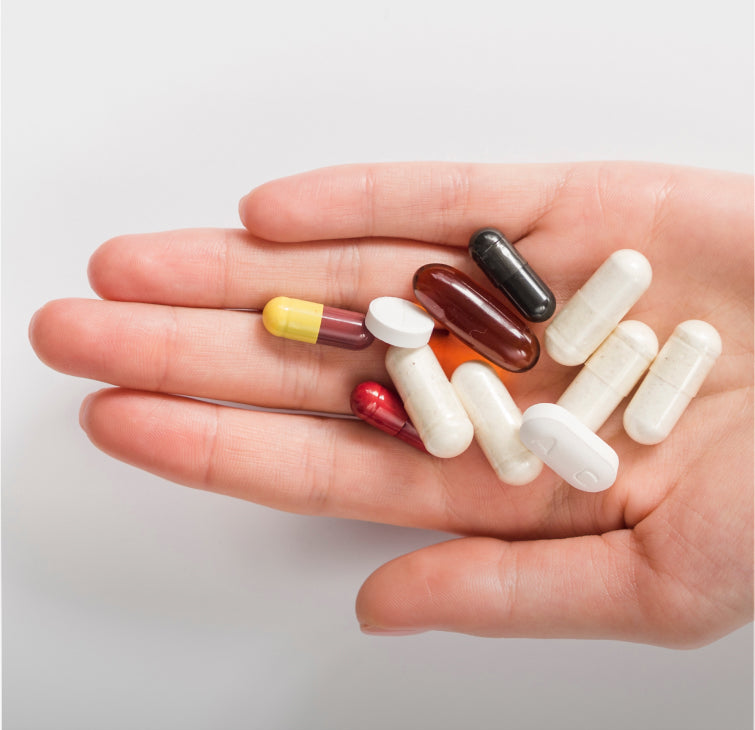
Magnesium bisglycinate helps regulate the stress response, reduce baseline cortisol levels and improve sleep quality — two factors directly linked to weight gain [6]. B vitamins, particularly vitamins B6 and B12, contribute to energy metabolism and the synthesis of neurotransmitters involved in mood, helping reduce stress-related compulsive eating behaviors. Plant-based fiber slows glucose absorption, limits insulin spikes and supports the gut microbiome, whose imbalance is associated with abdominal weight gain.
At Argalys, we have formulated a supplement without phytohormones or any direct hormonal effect, combining magnesium bisglycinate, vitamins B6 and B12, plant-based fiber and other targeted active ingredients to support nervous system balance, sleep and metabolism throughout the menopausal transition.
What you need to know about menopause and weight gain
Weight gain during menopause is not inevitable, despite the role of inherited genetic factors.
It also depends on specific biological mechanisms: fat redistribution towards the abdomen, a slower metabolism, insulin resistance, increased cortisol, sleep disturbances and muscle loss.
Adapting your diet, combining strength training with regular physical activity, restoring good-quality sleep and managing stress are the most well-documented approaches. Targeted nutritional supplementation can help support these adjustments.
Understanding and accepting the changes caused by menopause makes it possible to adapt to them and maintain the best possible quality of life.
References
[1] Ombrel.fr. Ménopause et graisse abdominale : rôle de la lipoprotéine lipase. Juillet 2026. Disponible sur : ombrel.fr. Perifit. Ménopause et prise de poids : comment éviter les kilos en trop ? Août 2025.
[2] Lizcano F, Guzmán G. Estrogen Deficiency and the Origin of Obesity during Menopause. BioMed Research International. 2014. — Pascal Nourtier Nutritionniste. Ménopause et insulinorésistance. Décembre 2025. Disponible sur : pnourtier.com. — Clinique Épithélia. Ménopause et poids : comprendre les mécanismes. Janvier 2025.
[3] Physionorm. Prise de poids à la ménopause. Mai 2026. Disponible sur : physionorm.fr. — Nutri&Co. Prise de poids et ménopause. Juillet 2026. — Novoma. Ménopause et prise de poids. Juin 2026.
[4] WeightWatchers. 6 stratégies utiles pour perdre du poids à la ménopause. Février 2026. Étude de revue : prise de poids 0,7 kg/an entre 40 et 50 ans. — American Psychologist, 2020 (cortisol et masse graisseuse). — Goldman Laboratories. La vérité sur la prise de poids pendant la ménopause. Décembre 2025.
[5] GFMER. Fluctuations pondérales à la ménopause. Enquête CERIS, plus de 1 000 femmes européennes sur 20 ans. Disponible sur : gfmer.ch
[6] Méthode Woman. Prise de poids ménopause : comprendre le rôle des œstrogènes, de l'insuline et du cortisol. Disponible sur : methodewoman.fr. — Omena App. Ménopause et perte de poids. Disponible sur : omena.app
[7] Sternfeld B, et al. Efficacy of exercise for menopausal symptoms: a randomized controlled trial. Menopause. 2014;21(4):330-338. Cité dans : JAMA Internal Medicine, 2014.